
Vitamin Supplements
DNA Tests



The Hidden Drivers of Male Fertility: Hormones, Gut Health, Micronutrients, and Metabolic Health
Published 17/06/2026
BackWhat men's health is really telling us
Browse the "fertility" aisle of the internet and a pattern quickly emerges. Folate, prenatal vitamins, and hormone-balancing smoothie recipes are almost always aimed at women. His side of the conversation tends to get summed up in a single sentence — usually involving the phrase "just relax" and a vague suggestion about avoiding hot baths. This Father's Day feels like the right moment to widen that conversation.
Male reproductive health doesn't exist in isolation. It's deeply connected to hormonal balance, metabolic health, gut function, and nutrition — which makes it worth paying attention to well beyond the question of fertility alone. This article explains:
Sperm health as a window into overall health
Here's something worth sitting with. A large study following over 78,000 men for up to 50 years found that those with healthier sperm tended to live longer — by an average of nearly three years — and developed chronic diseases like heart disease and diabetes significantly later in life. A long-term Danish study reinforced this, finding that men with lower sperm counts were hospitalised earlier and more often, particularly for cardiovascular disease and diabetes.
The takeaway isn't that sperm health causes longevity. It's that sperm health appears to be a reliable window into a man's overall health — shaped by the same hormonal, metabolic, and lifestyle factors that drive chronic disease risk more broadly. The conversations we tend to have separately — heart health, hormones, fertility — are, biologically speaking, one conversation.
The hormones behind male reproductive health
Most people know testosterone is the central player in male hormonal health. It drives sperm production, libido, muscle mass, mood, and bone density. But it doesn't work alone — and understanding the supporting cast matters.
LH and FSH
These two hormones, released by the brain, act as instruction signals — telling the testes when and how much testosterone to produce, and when to get on with making sperm. They are the upstream controllers of the whole system.
Oestrogen
Men have it too, and in the right amounts it actively supports bone health and fat distribution. Most male oestrogen is produced when testosterone is converted by an enzyme called aromatase — primarily in fat tissue, which gives body composition a direct role in hormonal balance.
SHBG
Sex Hormone-Binding Globulin binds to testosterone in the bloodstream and determines how much of it is actually available to use. Bound testosterone is inactive, so high SHBG can mean low effective testosterone even when total levels look perfectly fine on a standard test.
Cortisol
The stress hormone acts almost like testosterone's rival — when one rises, the other tends to fall. Chronically elevated cortisol also drives cravings and visceral fat accumulation, which feeds directly back into the aromatase story above.
The metabolic engine room
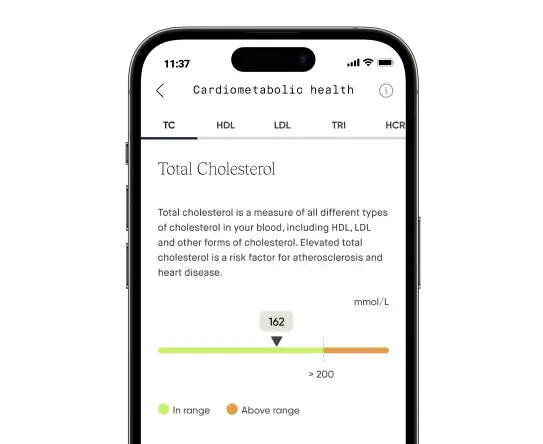
This is where things become genuinely interesting, because the biomarkers usually filed under "heart health" — cholesterol, blood pressure, blood sugar, inflammation — are far more entangled with hormonal and reproductive health than most people realise.
Both subcutaneous fat (stored beneath the skin) and visceral fat (stored around the organs) function as an aromatase factory. As fat tissue increases, more testosterone gets converted to oestradiol, leaving less available — which in turn encourages even more visceral fat storage. The feedback loop runs in a frustrating circle: low testosterone promotes visceral fat gain, visceral fat increases aromatase activity, more testosterone gets converted to oestrogen, and rising oestrogen suppresses the brain signals that drive testosterone production in the first place.
Insulin resistance is woven tightly into this picture. Obesity and insulin resistance can directly suppress the signalling pathway between the brain and the testes, and the relationship runs both ways — low testosterone also worsens insulin resistance. Chronic low-grade inflammation, often measured via C-reactive protein (CRP), is the connective tissue running through all of it: linking excess body fat, suppressed testosterone, and poorer metabolic health in a single, self-reinforcing system.
The good news is that this system is genuinely responsive. Moderate, sustained weight loss alongside good nutrition and lifestyle habits has been shown to produce real improvements in sperm health — and those improvements tend to hold as long as the healthy habits do.
“The biomarkers we file under heart health are far more entangled with hormonal and reproductive health than most people ever realise.”
Enter the gut
Here's the part that surprises most people: your gut bacteria have opinions about your hormones. Researchers have coined a term for this — the "microgenderome" — to describe the interaction between the gut microbiome, immune function, and reproductive hormones.
A diverse, well-balanced microbiome helps regulate inflammation and immune function, which supports insulin sensitivity. Good insulin sensitivity is one of the key conditions the body needs to maintain healthy metabolic function, which in turn supports the communication between the brain and the testes. When that communication runs smoothly, testosterone production and sperm development follow. The gut isn't a separate conversation from hormonal health — it's where a significant part of that conversation begins.
There's a direct link back to the oestrogen story, too. Once oestrogen has done its job, the liver packages it up for removal. But certain gut bacteria produce an enzyme called beta-glucuronidase, which can unpackage that oestrogen and send it back into circulation before it ever leaves the body. Research suggests that higher fibre intakes are associated with lower beta-glucuronidase activity — which may support better oestrogen clearance and a healthier hormonal balance overall.
Building a hormone-supportive plate
So what does a fertility- and hormone-supportive plate actually look like? It's less complicated than most people expect, and it maps closely onto guidance for heart health, gut health, and metabolic health — which is rather the point.
Fibre-rich carbohydrates (¼ of the plate)
Oats, whole grains, legumes, and sweet potatoes stabilise blood sugar, support insulin sensitivity, and feed the gut bacteria that regulate hormone metabolism. Diets built around these foods are consistently linked to better sperm quality; diets built around refined grains and sugary drinks are consistently linked to the opposite.
Plant proteins (¼ of the plate)
Lentils, chickpeas, beans, edamame, tofu, nuts, and seeds bring both protein and fibre diversity. Research shows that people eating 30 or more different plant foods per week have meaningfully higher gut microbial diversity — and a more diverse microbiome supports the hormonal environment described throughout this article.
Colourful vegetables and fruit (½ of the plate)
Peppers, broccoli, tomatoes, leafy greens, berries, and citrus deliver antioxidants — vitamins C and E, beta-carotene, lycopene — that help shield sperm from the oxidative damage affecting their quality, motility, and DNA integrity. Leafy greens also provide folate, which supports sperm DNA synthesis and is not just a nutrient for women.
Healthy fats
Omega-3s from oily fish, walnuts, chia, and flaxseed support sperm membrane integrity, help manage the chronic inflammation described earlier, and contribute to the satiety and metabolic health that makes the rest of the dietary picture easier to sustain long-term.
A few micronutrients deserve special mention. Zinc and selenium — found in seafood, pumpkin seeds, and Brazil nuts — are essential for healthy sperm development and testosterone production. Vitamin D, best obtained through sensible sun exposure and oily fish, plays a role in testosterone synthesis. CoQ10, found in organ meats, oily fish, and legumes, supports the energy production that sperm cells depend on to function well. These nutrients work together, which is why variety across the whole plate matters far more than any single superfood.
FAQs
Can lifestyle changes genuinely improve sperm health?
Yes. Research consistently shows that moderate weight loss, improved diet, better sleep, and stress management can produce measurable improvements in sperm count, motility, and morphology. These improvements tend to be sustained as long as the healthier habits are maintained, which means small, consistent changes are more valuable than short-term overhauls.
What is the link between testosterone and metabolic health?
The relationship is bidirectional. Low testosterone can worsen insulin resistance and encourage visceral fat gain, and insulin resistance in turn suppresses the hormonal signalling that drives testosterone production. Improving metabolic health through diet, exercise, and weight management can meaningfully support testosterone levels — and vice versa.
Why does gut health matter for male hormonal health?
The gut microbiome plays a direct role in regulating inflammation and insulin sensitivity, both of which influence the hormonal environment. Certain gut bacteria also affect how oestrogen is cleared from the body. A diverse, fibre-rich diet supports a healthier microbiome — and that, in turn, supports better hormonal balance.
What blood markers are worth checking for men concerned about hormonal health?
A useful panel would include fasting glucose (to assess insulin sensitivity), a full lipid profile, CRP as an inflammatory marker, total and free testosterone, SHBG, and vitamin D. Viewing these together provides a much clearer picture of what's driving what than any single result in isolation.
Does sperm health only matter if you're trying to conceive?
Research suggests not. Long-term studies have found that men with healthier sperm tend to live longer and develop chronic diseases later in life, even after accounting for other health factors. Sperm health appears to reflect the same underlying hormonal and metabolic environment that determines broader long-term health — which makes it worth paying attention to regardless of fertility plans.
The bottom line
Heart health, gut health, weight, hormones, and fertility are, biologically speaking, one conversation — and a plate built around fibre-rich carbohydrates, plant proteins, colourful vegetables, and healthy fats supports all of it at once.
For men curious about where they personally stand, a blood panel covering fasting glucose, lipids, inflammatory markers, testosterone, and SHBG — read alongside a microbiome assessment — can paint a far clearer picture than any single result ever could.