
Vitamin Supplements

DNA Tests



What Does “Liposomal” Mean?
Terms like liposomal, methylated, and bioavailability are often used in supplement marketing, but they’re rarely explained clearly. This article breaks down what those terms actually mean, why they matter, and how they connect to individual differences in methylation. In SD-01, nutrients are delivered using liposomal technology. Liposomes are tiny spheres made from phospholipids - these are the same structures that make up human cell membranes.
Encapsulating nutrients inside liposomes helps:
-
Protect them as they pass through the digestive system
-
Reduce degradation before absorption
-
Improve nutrient bioavailability
In practical terms, liposomal supplements are designed so that more of the nutrients listed on the label actually reach the bloodstream and are available for use.
Why Bioavailability Matters
Many traditional supplements are delivered as tablets or capsules that must first break down in the gut. During this process:
-
Some nutrients degrade
-
Others compete for absorption
-
A proportion may pass through unused
Because SD-01 is a liquid liposomal multivitamin, nutrients arrive at the point of absorption more intact. The goal isn’t higher doses, it’s better delivery. This distinction matters because what’s listed on a label is not always what the body can access or use.
What Are Methylated Vitamins?
SD-01 includes a methylated B-complex, meaning these B vitamins are already in their active form. Standard B vitamins must be converted by the body before they can be used. Methylated vitamins reduce the need for this conversion step, which can be particularly relevant for people with genetic variations affecting methylation pathways.
This is why methylated vitamins are often discussed in relation to:
-
Energy metabolism
-
Cognitive function
-
Nervous system support
The aim isn’t to bypass the body’s systems, but to support natural biochemical processes more efficiently.
Understanding Your Methylation Pathways (Including MTHFR)
Methylation is not a single reaction, it’s a network of interconnected biochemical cycles, including the folate, methionine, BH4, and transsulphuration pathways. These cycles play roles in energy production, neurotransmitter synthesis, detoxification, and the activation of certain nutrients.
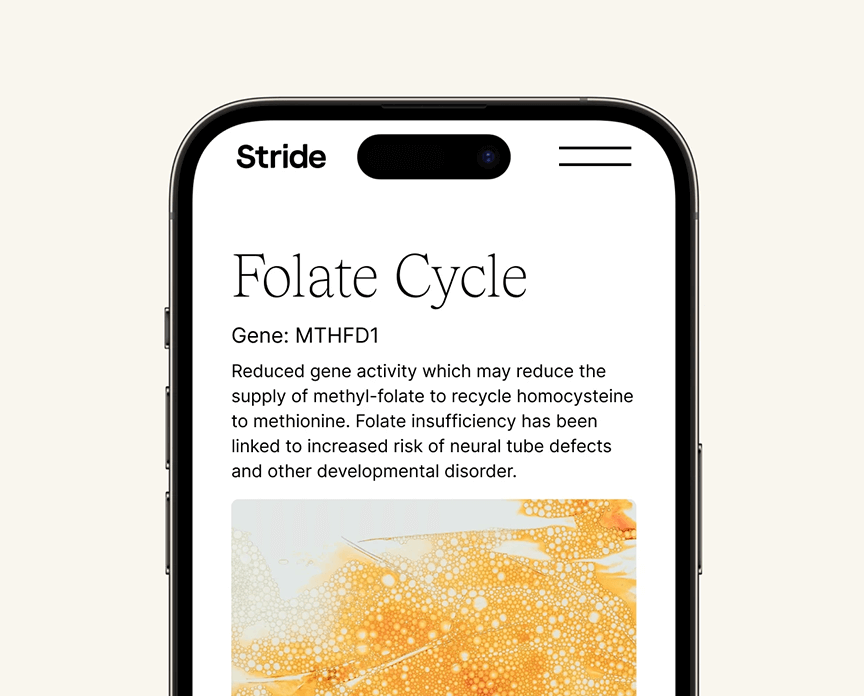
Genes involved in these pathways influence how efficiently methylation occurs. One of the most well-known is MTHFR, a gene involved in converting folate into its active form: 5-MTHF. Variations in MTHFR can affect how efficiently this process runs, which is why some people respond better to methylated forms of folate and B vitamins than others.
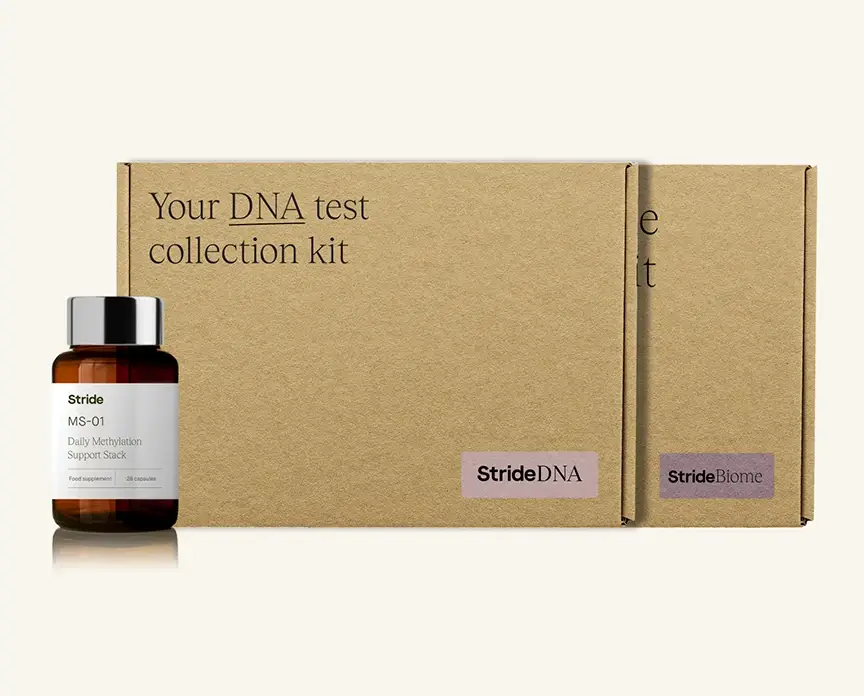
At Stride, our DNA-based Methylation Profile Reports look at key genes involved in these cycles (including MTHFR) to help you understand how your methylation pathways are wired.
Rather than guessing whether methylated vitamins are right for you, genetic insight can help explain:
-
How efficiently you activate folate and B vitamins
-
Where certain pathways may be under more demand
-
Why your response to supplements may differ from someone else’s
This context allows methylated, liposomal vitamins like SD-01 to be used more deliberately and with greater confidence.
One Formula Instead of Multiple Supplements
Many people end up taking:
-
A methylated B-complex
-
A separate antioxidant supplement (e.g. vitamins A, C, and E)
-
Additional standalone micronutrients
SD-01 brings these together in a single formulation, with 15 active ingredients, delivered in a liposomal liquid format. This reduces:
-
Pill burden
-
Variability in absorption
-
The need to stack multiple products
The focus is on simplicity and consistency, not excess.
Why Liquid Delivery?
Liquid supplements are often easier to take and can be gentler on digestion. When combined with liposomal delivery, liquid formats allow nutrients to be:
-
Absorbed more efficiently
-
Delivered more consistently
-
Taken without relying on tablet breakdown
For people who struggle with large pills or complex supplement routines, this can improve adherence and day-to-day consistency.
The Bottom Line
SD-01 combines two evidence-based principles:
-
Liposomal delivery to improve nutrient bioavailability
-
Methylated vitamins to reduce reliance on metabolic conversion
When paired with genetic insight from Stride’s Methylation Profile DNA Reports, this approach moves supplementation from guesswork to understanding, supporting smarter, more personalised nutrition.
Frequently Asked Questions
Are liposomal vitamins better absorbed?
Liposomal delivery is designed to protect nutrients during digestion and improve bioavailability, meaning more of the nutrient reaches the point of absorption intact.
What does “methylated” mean in vitamins?
Methylated vitamins are already in their active form, so the body doesn’t need to convert them before use. This can be particularly relevant for B vitamins involved in energy and nervous system function.
What is MTHFR and why does it matter?
MTHFR is a gene involved in converting folate into its active form. Certain genetic variations can affect how efficiently this process occurs, which may influence how someone responds to standard versus methylated forms of folate and B vitamins.
Should I take methylated vitamins if I have an MTHFR variant?
Some people with MTHFR variants report feeling better on methylated forms, but responses vary. A DNA-based methylation report can provide context to help guide supplementation choices rather than relying on trial and error.
Why not just take separate supplements instead of a multivitamin?
Taking multiple supplements can increase pill burden and lead to inconsistent absorption. A combined, liposomal liquid multivitamin simplifies delivery and routine.